
The conscious gardener
Battle of the bulb, by Ros Ball

Battle of the bulb, by Ros Ball
As a reader of Radicle I suspect that you, like me, are well acquainted with current world events. It can be easy to slip into a bottomless feeling of impotence in the face of them. Watching billionaires and autocratic rulers skip across continents, claiming land, raking in unimaginable wealth, leaving you aghast and wondering what you can do to make any kind of difference.
When I feel overwhelmed, which I do regularly, I try to bring my focus back to a smaller scale and look around me at things within my own control. Things in my everyday life but also in my professional life. In the scope of gardening it may feel as though we have little power, but there are examples of change happening. We have driven forward use of peat free compost, advocated for wildlife, and saved green spaces. Pushing for progress to mitigate the climate emergency feels like it’s in our wheelhouse and we can be easily motivated by its aims. But what about other forms of social and political progress in our industry? You’ve heard of conflict diamonds, which are diamonds mined in a war zone and sold to finance the war, but what about conflict seeds and bulbs?
I attended my first demonstration in support of Palestine in late October 2023. I was horrified by the reckless killing of thousands of civilians who were already living under apartheid, their land illegally occupied, and stripped of their human rights. A newcomer to the struggle, I wasn’t knowledgeable about the history but I was moved to act by the hypocrisy of the global response, by countries who claim to live by the rules of international law but were endlessly overlooking them when the brown bodies of Palestinians were the ones left to die by the thousands. On remembrance Sunday 2023, being at the Palestine solidarity protest made much more sense than at the cenotaph because remembrance is the action we take to prevent all wars, so what could be a better way to remember war dead than to advocate for those who may die any day? And die they did. The death toll is now believed to be over 70,000, which does not include those who remain missing. At least 10,000 are presumed to be buried under rubble. A Lancet report from 2024 estimated that accumulative effects mean the true death toll could reach more than 186,000 people1.
A group of like-minded gardeners came together to protest, to raise awareness and also bring other gardeners along with us, and so a tiny initial group of ‘Gardeners for Palestine’ was brought together. A banner was made from a white flannel bed sheet with green, red and black letters cut from scrap material, and in the corners two olive branches made from felt. Of course we chose the olive, so pertinent to the Palestinian identity and economy, knowing that the estimates of numbers of trees destroyed since the Israeli occupation began in 1967 is in the hundreds of thousands. As gardeners the trees were always going to feature foremost in our minds as symbols of ecological colonialism but also of indigenous and racial repression. Around the world there is a pattern of people stripped of the things that give them connection to the land in order to control them, for Palestinians foraging their native plants is banned just as in the USA foraging had been banned to prevent Indigenous people and freed enslaved people from feeding themselves.
The group has continued to meet and march since then and our banner is a communal space where any supporter can contribute a handmade cloth Palestinian flower which will be sown onto the banner. Faqqu’a iris, poppy and cyclamen all feature and some of the flowers are embroidered with the names of families in Gaza, so we carry them with us.
Protesting is one thing you can do but not everyone is able to attend or might choose this way to bring about change. Donating directly to families in Gaza through mutual aid funds is always needed and this can be specifically related to our industry. I have recently been supporting a delightful young father, Ahmed Ibrahim, who used to farm and build greenhouses in Gaza before the genocide left him desolate and living in a tent like thousands of others. In solidarity with a fellow land worker, do help him here if you can.
Let’s turn to one of the most successful forms of long-term pressure people can assert to push for change outside of failing international systems- the boycott. One of the most successful stories being the worldwide boycott of South African produce and culture in opposition to apartheid, which finally ended in 1994.
The current equivalent is the Palestinian boycott, divestment and sanctions (BDS) movement which, “urges action to pressure Israel to comply with international law.” It feels ridiculous to have to say this, but produce from occupied land is strictly illegal under international law - one of the reasons you may not be aware is because this is one of the points of hypocrisy where international law is regularly sidestepped. Following a landmark advisory ruling by the International Court of Justice (ICJ) in 2024 Amnesty International says the EU’s current policy of distinguishing between goods produced in Israel and those produced in settlements, falls short of these obligations which it says “require a complete ban on trade and business with Israel’s illegal settlements.” The UK uses this system too and Amnesty says “it shouldn’t be possible for goods produced in Israeli settlements in the occupied West Bank and East Jerusalem to be available in the UK”, and yet they continue to be.
If we can’t rely on our government to impose international law, the equivalent of a legal boycott, then we must impose it ourselves, and many have been doing just that. A recent Mondoweiss article says Israeli farmers are warning the country’s agricultural export industry is facing a looming “collapse” due to international opposition to the Gaza genocide and that the Israeli ‘brand’ may never recover. UK consumers have been active in pressuring supermarkets to stop stocking Israeli produce with evidence of success when the Co-op announced in June 2025 it would stop sourcing goods from Israel, Iran and 15 other countries where it says there are “internationally recognised” rights abuses and violations of international law. Boycotts work.
Let this be grist to our mill for our own industry. Step forward Ethics in the Garden who say “a group of us in the industry and keen hobby gardeners are increasingly aware how our activities are contributing to the situation in the Middle East and we would like to play our part and make our industry and gardens more ethical, conflict-free and apartheid-free.” Starting with a conflict-free seeds campaign, they’ve created an excellent leaflet listing safe seed companies to use. They have been writing to seed companies asking them to verify where their stock comes from. So far they are endorsing Real Seeds, Vital Seeds, Winnow Farm Seeds, Seed Revolution and Franchi Seeds of Italy.
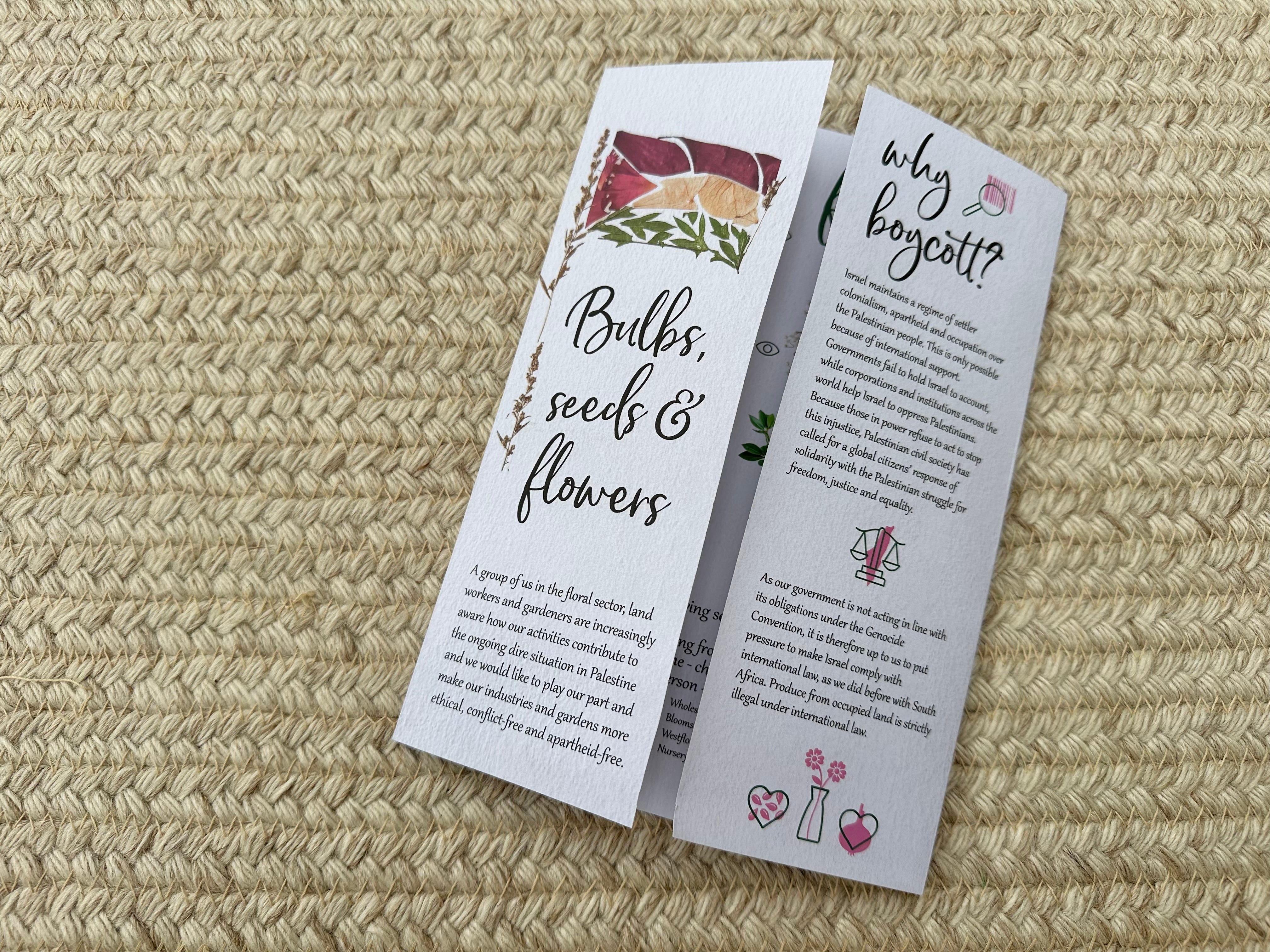
In 2023, Israel exported seeds (for sowing) valued at around $108 million, ranking it as the 19th largest exporter of seeds globally out of 180 countries2. Israel is also a major exporter of bulbs especially ranunculus and narcissi. Belle de Londres has written a useful summary of companies that buy from Israel and a great list of those that don’t, including: Scamps Daffodils, Shipton Bulbs, Thomas Etty, and Avon bulbs.
One of the things that lifts my heart when it comes to injustice are these groups that are formed and work, toiling behind the scenes doing the small actions that add to the wider purpose. You think Gardeners for Palestine is niche? Our banner inspired Knitters for Palestine, and there’s a dedicated group from the wedding industry who have ensured their couples can choose a conflict-free wedding. Every little helps, l believe they say, or rather as Ethics in the Garden says: “Let our gardens symbolise positive choices for peace and justice.” And what garden could be more beautiful than that?
Ros Ball sells cut-flowers grown in under-used front gardens in South London as The Front Garden Flower Farm. She is also a self-employed gardener, author and occasional journalist. You can find Ros on Instagram @frontgardenflowerfarm and @ros_but_growing
Ros is being paid for this article.
https://www.thelancet.com/journals/lancet/article/PIIS0140-6736(24)01169-3/fulltext
https://oec.world/en/profile/bilateral-product/sowing-seeds/reporter/isr